
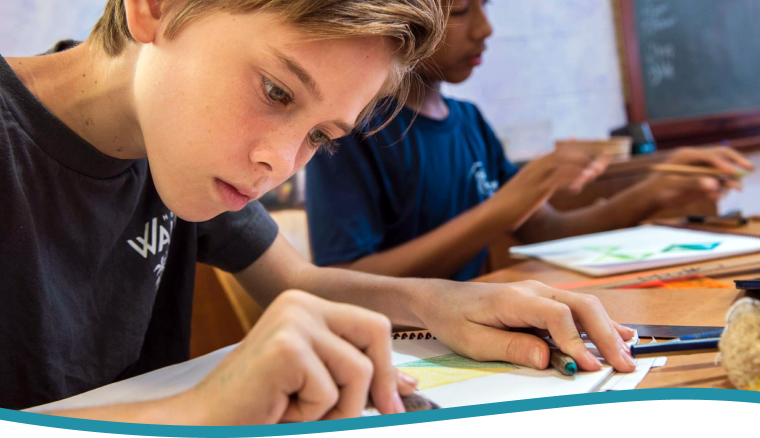
Waldorf education is noted for the depth and breadth of its curriculum, which follows the developmental stages of childhood and reflects the inner transformation of the child from year to year. In this way, the child’s educational experience remains relevant, meaningful, and satisfying. The curriculum awakens in the child an appreciation and respect for cultural origins and historical foundations, fostering a sense of belonging and world citizenship.
The Waldorf approach to the sciences, as with many other aspects of the curriculum, is experiential and encourages a genuine interest in and love for nature and scientific inquiry. The arts are integrated throughout the curriculum, developing imagination, creativity, joy in learning, self-discipline, confidence, and skills that enrich children both individually and in community throughout their lives.
At Honolulu Waldorf School, every morning begins with the Main Lesson. For the first two hours of the day, each class studies an academic subject—such as mathematics, science, social studies, or language arts—in blocks of approximately four weeks. This concentrated period allows the children and their teacher to immerse themselves deeply in the material. There is time for projects, individual and group work, artistic activities, field trips, exploration, and discussion.
Each child creates a Main Lesson book that gathers and expresses the essential content of the block through writing and illustration. Over the course of the block, the book becomes the student’s own record of learning and a unique text of the subject studied.
The art of storytelling is a major component of the Waldorf curriculum, and each grade is associated with particular stories and themes that correspond to the child’s stage of development. Beginning with fairy tales and folk tales from around the world in first grade, stories help relate curriculum content to the human experience, giving students a vivid and personal relationship to their lessons. Through stories, the student’s feeling life is engaged, memory is strengthened, and the will to act is awakened.
The Main Lesson is taught by the Class Teacher, who remains with the class for a number of years. This continuity allows the teacher to develop a deep understanding of each child and of the class as a whole. The Class Teacher also teaches additional lessons during the school day and brings continuity and rhythm to the children’s experience throughout the week.
During the rest of the day, the children study and participate in a wide range of other subjects. Japanese and Spanish are taught in alternating blocks throughout the week. Singing, painting, games and physical education, Nā Mea Hawaiʻi, instrumental music, handwork, mathematics, and language arts weave rhythmically through the week. Many of these subjects are taught by specialized Subject Teachers.
Special events, excursions, festivals, and celebrations are woven throughout the school year. Each class performs a grade-appropriate play that deepens the students’ connection to a topic studied during the year. Music classes perform for holidays and school concerts, and students participate in festivals such as May Day, Michaelmas, and the Winter Festival.
Our classes also take advantage of artistic and cultural opportunities offered by community groups and travel around the island to visit farms, cultural sites, and other places that expand their experience of a subject while connecting them more deeply to their island home. Visitors are welcomed to the school to share their knowledge and expertise in a particular craft, art, or field of study. Overnight class trips begin in Grade Four with a visit to a local farm and expand as the children grow in maturity and independence.
The Grade One through Five curriculum offered at Honolulu Waldorf School forms a connected and developmental whole. Each year provides a foundation for the next and builds upon what has come before. This progression is part of the larger Waldorf educational journey, in which the experiences of the elementary years prepare students for increasingly independent thinking, inquiry, and intellectual engagement as they mature.
The overview of each grade presented here is intended to be instructive rather than definitive. While the essential themes and developmental foundations of each grade remain consistent, the ways in which the curriculum is brought to the students will vary from class to class and from year to year, reflecting the particular children, teacher, and community.
Our school day begins promptly at 7:55 a.m. and ends at 2:45 p.m. On Wednesdays, students are dismissed early at 2:00 p.m.
GRADE ONE
Entering the first grade is a major transition in the life of the child. The first grader leaves the homelike world of the Early Childhood Department, and enters the more structured environment of the grades classroom. World-wide Fairy tales, folktales, and nature stories constitute the basic story material of First Grade and these stories provide food for the soul of the child and nurture the capacity to learn in a way that is joyful and enriching. This power of imagination develops the ability to think creatively. The excitement of learning to write, read, and do math is supported through movement, music, and art.
- Form Drawing awakens the children to spatial relationships and helps develop the coordination of eye and hand, as well as laying a foundation for reading and writing
- Japanese and Spanish language and culture are introduced through songs, verses, stories, finger plays, and games
- Weekly lessons in modeling and painting develop an artistic aesthetic and build the powers of creativity
- Knitting is learned, children learn to create lovely toys while knitting trains the brain
- Na Mea Hawai‘i classes continue the Hawaiiana circles introduced in kindergarten through Hawaiian songs and stories.
GRADE TWO
Second graders are at ease with their school routine and with their teachers, and they are eager to learn. Animal fables and stories of world-wide saintly people constitute the story material of the Waldorf Second Grade. The legends exemplify all that is highest and most noble in human striving, while the fables amusingly recount the less desirable qualities of the human being, and these two perspectives mirror the polarities that the second grade child experiences. The students are continuing on their path of joyfully learning to read and further developing their skills in the four arithmetic processes of addition, subtraction, multiplication, and division.
- After learning to play wooden pentatonic flutes in Grade One, the Second Graders further develop their music skills and in handwork class crochet beautiful cases for their flutes
- World Language classes engage all the senses as the children taste the foods, sing the songs, recite the poetry, and play the active games of each culture
- The foundations of hula are introduced in Na Mea Hawai‘i
- In form drawing, students continue to master forms and shapes, and through drawing mirrored forms, clearly distinguish left and right, up and down, strengthening sensory integration
GRADE THREE
Third graders are experiencing an awakening self-awareness,which is reflected in the stories of the Hebrew people told that year. These stories are filled with archetypal descriptions of human beings facing good and evil, being “cast out of paradise,” and taking hold of the world and making it fruitful and abundant. The practical activities in Third Grade, which include gardening and farming, house building, and measurement. In math, regrouping in addition and subtraction is mastered, and long multiplication and division are introduced. Telling time and measurement are important main lesson blocks. The students become more masterful writers, and work with grammar and punctuation.
- Adding to the knitting stitch learned in first grade, third graders learn to perl and create hand puppets
- Mirrored forms in four quadrants are the challenging subject in Form Drawing
- Singing and flute playing continue, with the introduction of call and response songs and rounds
- Water color painting takes on more form, painting various motifs from the curriculum
GRADE FOUR
The fourth grade students wish to further explore their world, and geography is an important subject introduced at this point, as it builds a sense of place and belonging. Local geography is introduced first, and the students become familiar with the topography and history of their school neighborhood, then the city, island, and state of Hawai‛i. The students draw their own maps and model relief maps with paper mache, beeswax, or clay. Fractions are introduced in math. Grammar studies continue, with further work with parts of speech and a focus on tenses. Animals and their relationship to human beings are the focus of science for the year. The story curriculum includes legends and stories of Old Hawai‛i, and Norse Mythology, stories of courage, strength, and cunning, which support the developmental needs of the fourth grade student.
- Complex Form Drawing includes woven knots and braids from the Old Norse tradition and forms based on fractions
- After working mostly orally in the first three grades, fourth graders are introduced to writing and reading in World Language classes
- Art classes focus on main lesson subjects, and the students paint and model a variety of animals from their zoology lessons
- Building on rounds in third grade, fourth graders begin part singing, and become more proficient on their stringed instruments
- Na Mea Hawai‘i classes include a focus on oli and Hawaiian protocol, as well as a field trip highlighting ancient sites of O‘ahu
- All students begin participating in Strings class, learning violin, viola, cello, or bass
- In Movement classes, students continue to play group games and work with fundamental skills to build a foundation for games and sports. Circus arts are part of the curriculum, including juggling, stilt-walking, and unicycle riding
GRADE FIVE
The Fifth Grade is a time when many children seem to strike a healthy balance between early childhood and approaching adolescence. It is appropriate, therefore, that the Waldorf curriculum for Grade Five seems aglow with balance and harmony. Fifth grade is a year of wonderful balance, where the children are finding themselves as individuals, yet still engaged in the heart of childhood. The “heart” of the curriculum, therefore, is the study of the balanced and harmonious world of the ancient Greeks, culminating in the students’ participation in a Greek pentathlon, where they travel to Maui, and with other Hawai‘i Waldorf schools, re-enact the ancient games of foot races, long jump, javelin and discus throwing, and wrestling.
- World History is introduced through the study of India, Mesopotamia, Egypt, Greece, and China
- Natural Science is approached this year through Botany, with an emphasis on the plant kingdom’s relationships to the human being
- In Mathematics, the class moves from fractions to decimal fractions. Reciprocals, averages, and the metric system are introduced
- In Form Drawing, the children work with motifs from the ancient cultures they are studying, and also work with more advanced freehand geometrical construction